OpenAI Compatible API
This is the HTTP API reference. For UI walkthroughs, see Getting Started and the feature guides above.
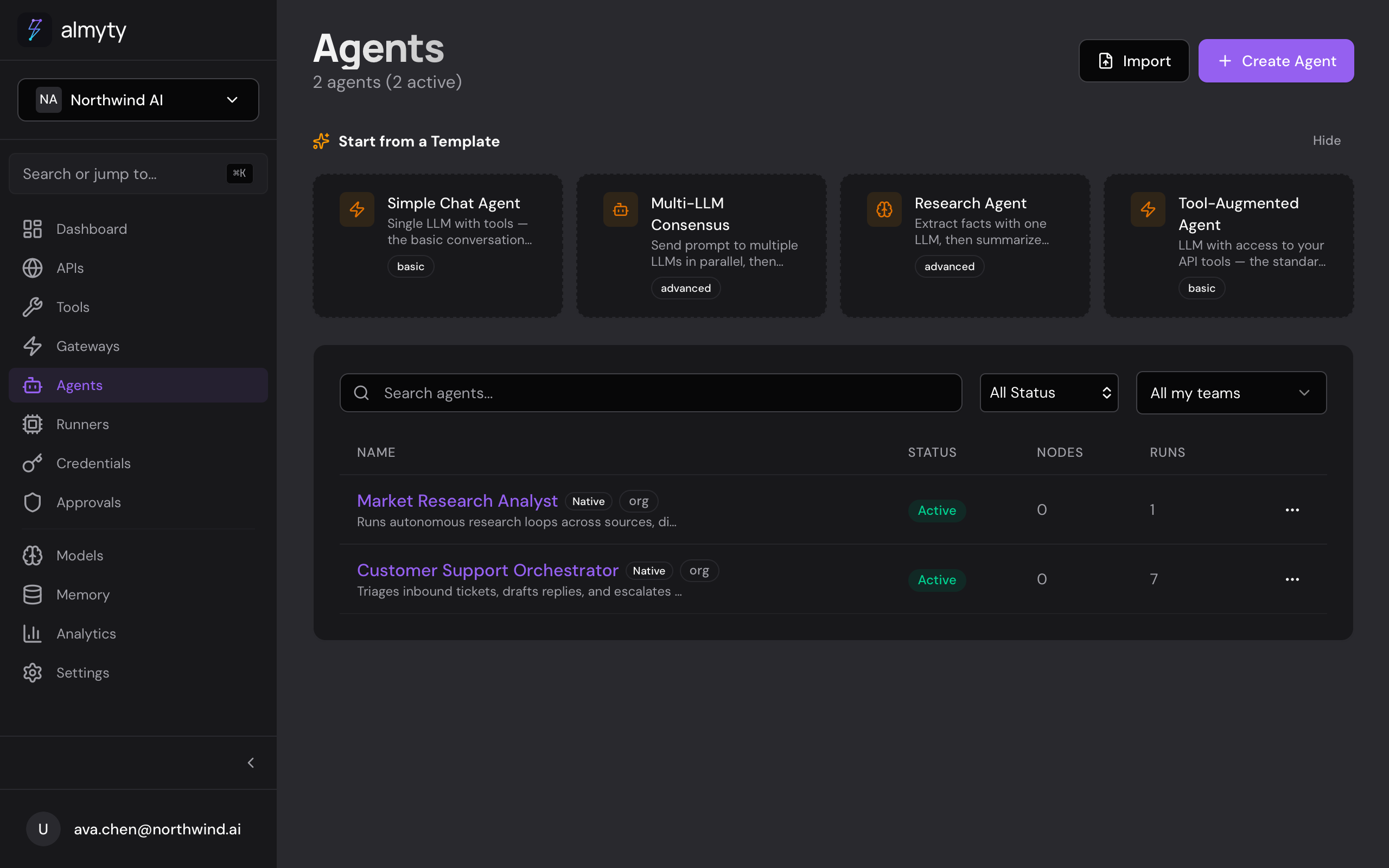
almyty agents can be invoked using an OpenAI-compatible chat completions API. This means any application that works with the OpenAI API can be pointed at an almyty agent without code changes.
Endpoint
POST https://api.almyty.com/agents/{agentId}/v1/chat/completionsRequest Format
The request follows the OpenAI chat completions format:
curl -X POST https://api.almyty.com/agents/{agentId}/v1/chat/completions \
  -H "Authorization: Bearer $TOKEN" \
  -H "Content-Type: application/json" \
  -d '{
    "model": "agent",
    "messages": [
      { "role": "system", "content": "You are a helpful assistant." },
      { "role": "user", "content": "What is the weather in Berlin?" }
    ],
    "temperature": 0.7,
    "max_tokens": 1024,
    "stream": false
  }'
Parameters
| Parameter | Type | Required | Description |
|---|---|---|---|
model | string | Yes | Use "agent" or the agent name |
messages | array | Yes | Array of message objects with role and content |
temperature | number | No | Override the agent’s default temperature |
max_tokens | number | No | Override the agent’s default max tokens |
stream | boolean | No | Enable streaming responses (SSE) |
tools | array | No | Additional tool definitions (merged with agent tools) |
Message Roles
| Role | Description |
|---|---|
system | System instructions (overrides agent’s system prompt if provided) |
user | User message |
assistant | Previous assistant response (for multi-turn conversations) |
Response Format
Non-Streaming
{
  "id": "chatcmpl-uuid",
  "object": "chat.completion",
  "created": 1711234567,
  "model": "agent",
  "choices": [
    {
      "index": 0,
      "message": {
        "role": "assistant",
        "content": "The current weather in Berlin is 12°C with partly cloudy skies."
      },
      "finish_reason": "stop"
    }
  ],
  "usage": {
    "prompt_tokens": 25,
    "completion_tokens": 18,
    "total_tokens": 43
  }
}
Streaming
When stream: true, the response uses Server-Sent Events:
data: {"id":"chatcmpl-uuid","object":"chat.completion.chunk","choices":[{"index":0,"delta":{"role":"assistant"},"finish_reason":null}]}

data: {"id":"chatcmpl-uuid","object":"chat.completion.chunk","choices":[{"index":0,"delta":{"content":"The "},"finish_reason":null}]}

data: {"id":"chatcmpl-uuid","object":"chat.completion.chunk","choices":[{"index":0,"delta":{"content":"current "},"finish_reason":null}]}

data: [DONE]
Tool Calling
If the agent has tools configured, the response may include tool calls:
{
  "choices": [
    {
      "message": {
        "role": "assistant",
        "content": null,
        "tool_calls": [
          {
            "id": "call_uuid",
            "type": "function",
            "function": {
              "name": "get_weather",
              "arguments": "{\"city\": \"Berlin\"}"
            }
          }
        ]
      },
      "finish_reason": "tool_calls"
    }
  ]
}
Submit tool results back:
{
  "messages": [
    { "role": "user", "content": "What is the weather?" },
    { "role": "assistant", "tool_calls": [...] },
    {
      "role": "tool",
      "tool_call_id": "call_uuid",
      "content": "{\"temperature\": 12, \"condition\": \"partly cloudy\"}"
    }
  ]
}
Integration Examples
Python (openai library)
from openai import OpenAI

client = OpenAI(
    base_url="https://api.almyty.com/agents/{agentId}/v1",
    api_key="your-almyty-token",
)

response = client.chat.completions.create(
    model="agent",
    messages=[
        {"role": "user", "content": "Summarize today's news"}
    ],
)

print(response.choices[0].message.content)
JavaScript (openai library)
import OpenAI from "openai";

const client = new OpenAI({
  baseURL: "https://api.almyty.com/agents/{agentId}/v1",
  apiKey: "your-almyty-token",
});

const response = await client.chat.completions.create({
  model: "agent",
  messages: [{ role: "user", content: "Summarize today's news" }],
});

console.log(response.choices[0].message.content);
Limitations
- The
modelparameter is accepted but ignored, the agent’s configured LLM provider is always used - Function calling follows the agent’s pipeline, not ad-hoc function definitions
- Token limits are subject to the configured LLM provider’s constraints