Approval Policies
Enterprise (approval_policy entitlement). Require the right people to sign off before a consequential action goes through: finance then an admin, two reviewers for a quorum, or a gate that only trips over a dollar threshold. Single-gate approvals (one authorized reviewer approves or rejects a paused run) are free and enough for most workflows. Approval policies add structured sign-off on top: multi-step chains, conditional matching (“only for refunds over $1,000”), and quorum (“any two reviewers”).
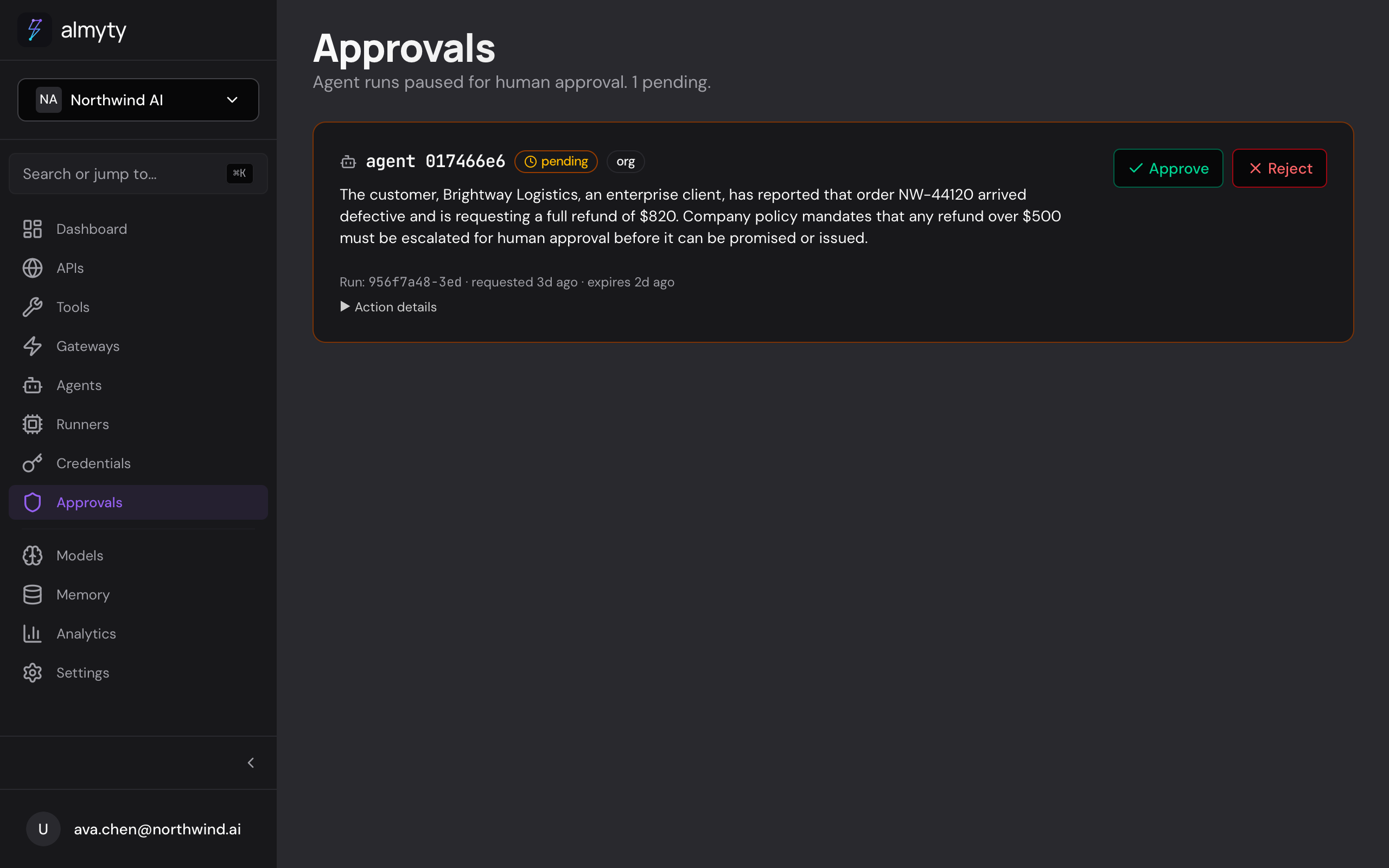
When no policy matches a request, the OSS single-gate behavior applies unchanged. Policies are an overlay, not a replacement.
Anatomy of a policy
Create policies under Settings, or via the API. A policy is a match condition, an ordered set of sign-off steps, and a priority:
{
  "name": "large-refunds",
  "match": [
    { "attr": "toolName", "op": "eq", "value": "issue_refund" },
    { "attr": "amount", "op": "gt", "value": 1000 }
  ],
  "steps": [
    { "name": "Finance review", "approverRole": "finance", "minApprovals": 1 },
    { "name": "Admin sign-off", "approverRole": "admin", "minApprovals": 1 }
  ],
  "priority": 10,
  "enabled": true
}match: conditions over the approval request’s context (agentId,toolName,amount, and whatever the requesting agent put in the payload), ANDed. Operators:eq,neq,gt,gte,lt,lte,in,nin. An emptymatchmatches every request.steps: ordered sign-off stages. Each step names anapproverRole(an org role or a custom role name;"*"accepts anyone authorized to approve) and aminApprovalscount (at least 1).priority: when several enabled policies match, the highest priority wins; exactly one policy governs a request.teamId: optional; scope the policy to one team’s agents.
A plain quorum is just a single step: { "approverRole": "*", "minApprovals": 2 }.
Evaluation rules
- Steps are sequential. Step 2 accepts no approvals until step 1 is satisfied. An admin clicking early doesn’t pre-fill a later stage.
- No double-counting. Each individual approval is credited to exactly one step. A user who holds both the finance and admin roles cannot satisfy both steps of the example above with a single approval: two distinct sign-offs means two people (or at minimum two explicit approvals).
- Progress is inspectable. Each pending request under a policy reports per-step state (required, collected, satisfied) and the current step, so the Approvals UI can show “1 of 2 stages complete”.
Managing policies
Policy CRUD (list, read, enable/disable, delete) is org admin/owner only, under Settings or the API reference. Reviewers themselves keep using the normal approve/reject actions from Approvals. The policy engine decides when the request as a whole is satisfied.