Examples
Real jobs, built end to end with almyty. Each recipe starts from the outcome, names its stack (trigger, models, tools, mode), and walks the concrete steps. Find the one closest to what you want, follow it, and swap in your own APIs and channels.
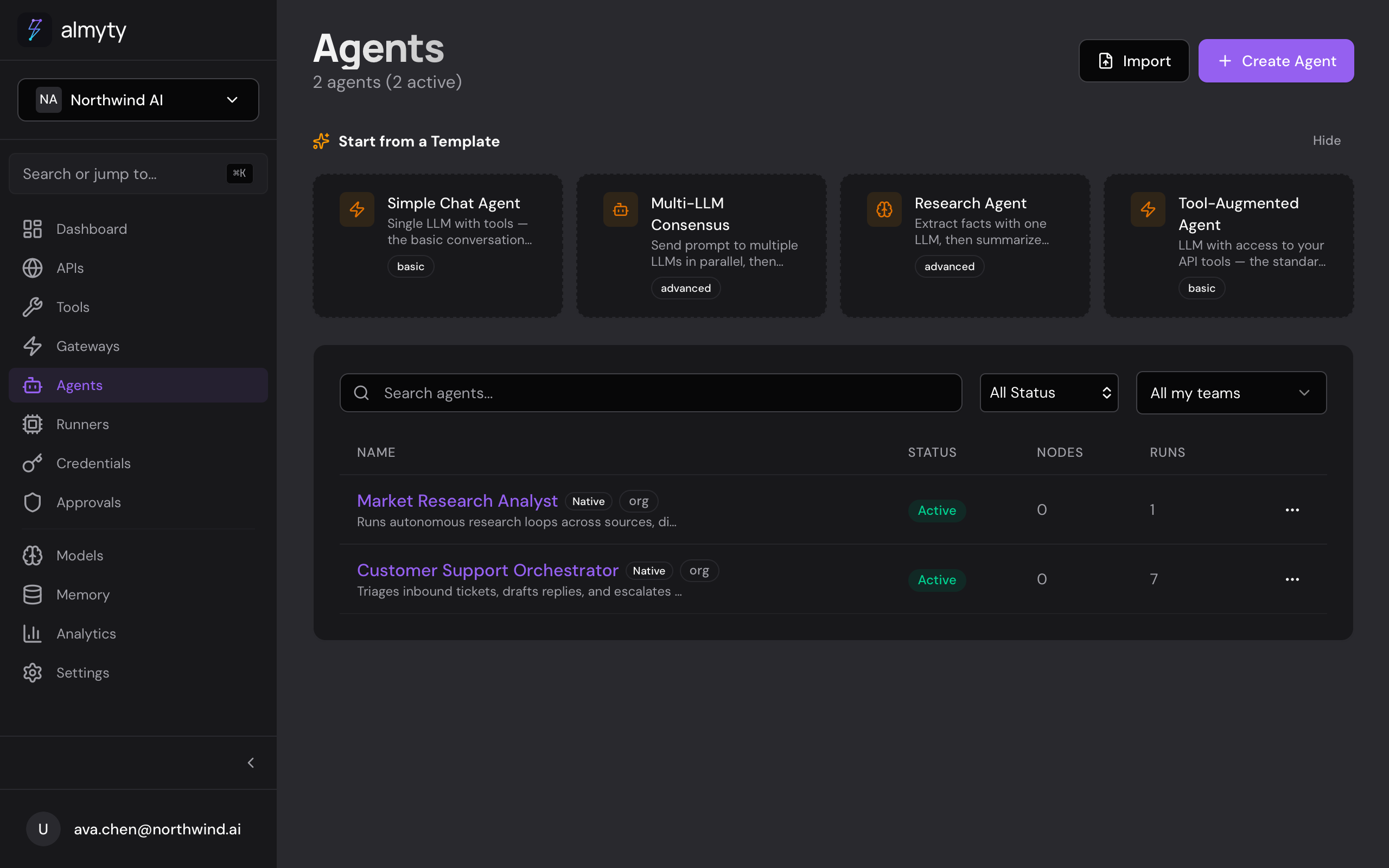
Every recipe is assembled from the same pieces: tools (any API or npm package you connect), gateways (how agents and clients reach them), agents, memory, and the runner. A name like “CRM API” means an API you connect, not a built-in connector.
Give your AI access to APIs and data
Turn the systems you already run into tools an agent can call.
- Give Claude Code your own API: import a schema, publish an MCP gateway, call it from Claude in one line.
- Modernize a legacy SOAP service: wrap a WSDL as modern MCP tools, source untouched.
- Turn an npm package into tools: point almyty at a package like
stripeand get typed tools. - Connect Google Drive and SharePoint: search and summarize your docs, then write back.
- Query your database in plain English: the agent writes and runs read-only SQL, and shows the query it used.
- Give an agent a machine to work on: expose a laptop, build server, or VPC box through the runner.
Automate real work
Put an agent on a recurring job, a channel, or a webhook and let it do the task.
- Triage support tickets and draft replies: looks up the order, drafts a reply, escalates refunds to a human.
- Deflect L1 questions from your docs: answers in-channel with a cited page, opens a ticket only when it cannot.
- Enrich and route inbound leads: scores against your ICP, writes back to the CRM, pings the right rep.
- Turn call notes into CRM updates: extracts next steps, updates the opportunity, drafts a follow-up.
- Triage and label GitHub issues: labels, links duplicates, routes, and requests repros.
- Review pull requests: flags bugs, missing tests, and policy violations inline, and never approves.
- Summarize on-call alerts: gathers metrics and logs, correlates with past incidents, posts a summary.
- Run a multi-vendor coding fleet: one planner driving Claude Code, Codex, and aider on a single repo.
- Post a nightly data-quality digest: checks freshness and anomalies on a schedule, reports only what is wrong.
- Reconcile Stripe payouts: matches Stripe against the ledger daily and reports only the exceptions.
- Run a cross-vendor contract review: several models argue the risks, a judge writes the memo.
Govern and secure agents
Add constraints, budgets, approvals, and access control before an agent touches production.
- Run a governed refund agent: constraints, cross-vendor verify, human approval, and a full audit trail.
- Govern AI spend across teams: per-team budgets with soft and hard caps, enforced at run start.
- Enforce approval policies org-wide: map action plus threshold to a required approver across every agent.
- Role-based access for a multi-team org: teams, per-resource roles, least privilege by default.
- Onboard with SSO and SCIM: SAML or OIDC sign-in, SCIM provisioning, groups mapped to roles.
- Stream your audit trail to a SIEM: every action to Splunk or Datadog, searchable and alertable.
Self-host and comply
Keep data in your network and meet regulatory requirements.
- Air-gapped, self-hosted agents: local models, data residency, nothing leaves your network.
- Ship EU AI Act-compliant agents: AI disclosure on every channel plus an Annex IV technical-doc export.