Runners
A runner is a small daemon you start on a machine — your laptop, a cloud VM, a Kubernetes pod, a Docker container, an edge device — anywhere Node runs. It connects that machine to almyty and exposes it to your agents: they run commands and use the local tools and files there, while every LLM call still goes through the backend. Your code and credentials never leave the machine.
Start a runner
Authenticate once, then start the daemon. It registers with almyty, reports the binaries it finds on the machine, and stays online listening for work.
npx @almyty/auth login
npx @almyty/runner start --name my-laptop
npx @almyty/runner status
It appears in the Runners page as online. Stop it with npx @almyty/runner stop or Ctrl-C in its terminal.
What an agent can do on it
The runner exposes a generic process surface — spawn, shell, read, write, signal — scoped to a workspace. So an agent can do whatever the machine can: run a build, query data that only lives there, operate a server, or drive a CLI it detects. The orchestration lives in the agent’s prompts; the runner just runs the processes.
Its capabilities (such as shell.exec and runner.info) are published as tools,
tagged with the runner’s name. Attach them to a gateway and any
agent can call them — one you built, or a Claude Code session over MCP.
Coding agents
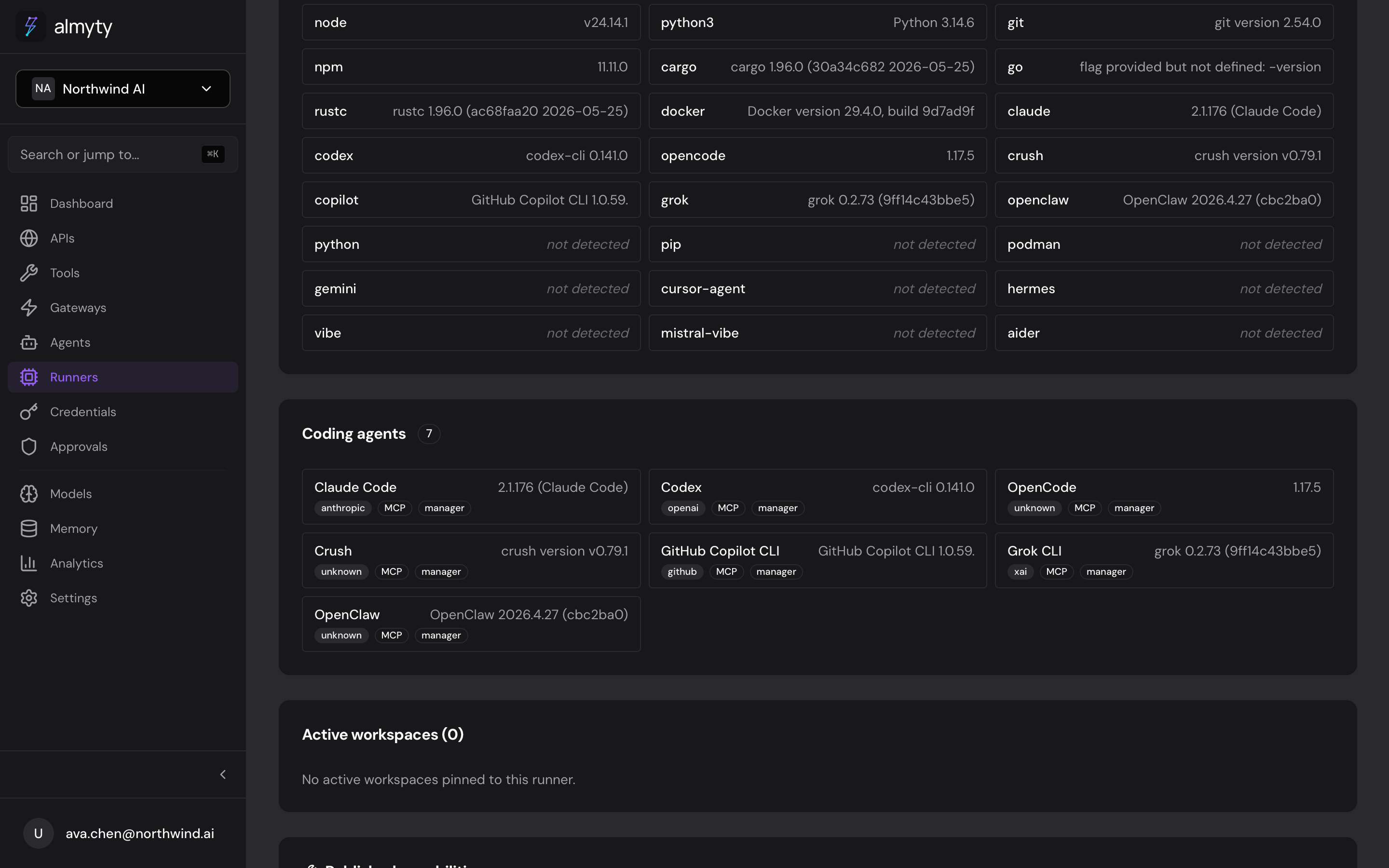
The runner natively drives the major coding-agent CLIs — Claude Code, Codex, Gemini, Cursor, aider, and more. It detects which are installed at startup (shown in the Coding agents card above) and can launch them as unattended members: it injects the provider key for headless auth, isolates each one’s config and session, enables auto-approve, and reports live status (busy / idle / awaiting input). That is the building block for a multi-vendor coding team — one agent driving several CLIs on the same codebase. You compose the orchestration; the runner runs the members.
Workspaces
Work happens inside a workspace: a reservation of a working directory on the runner, with a time limit. Processes are isolated per workspace and cleaned up when it is released, so one job cannot reach another’s files.
Notes
- One runner per account in v1.0; multi-machine scheduling is on the way.
- Where LLM calls happen. almyty’s own agents run their LLM calls through the backend, not the runner — the runner just executes local processes. The exception is the coding-agent CLIs you spawn on the runner: they authenticate to their provider directly with a key you supply, so those calls leave from the machine itself.
Related
- Gateways — publish a runner’s capabilities as callable tools
- CLI: the runner — install and flags
- Self-hosting — run almyty itself on your own infrastructure