🧾 Stream your audit trail to a SIEM
Stack: Source: every action (who/when/what) · Export: JSON / SIEM · Sinks: Splunk, Datadog, your log pipeline · Output: agent activity in your security stack
Who it’s for: security and compliance teams who need agent activity in the same place as everything else they monitor. What it does: every action an agent takes and every change to its config is recorded with who, when, and what. You export that audit trail, as JSON or into your SIEM, so agent behavior is searchable, alertable, and retained alongside your other logs.
Build it
-
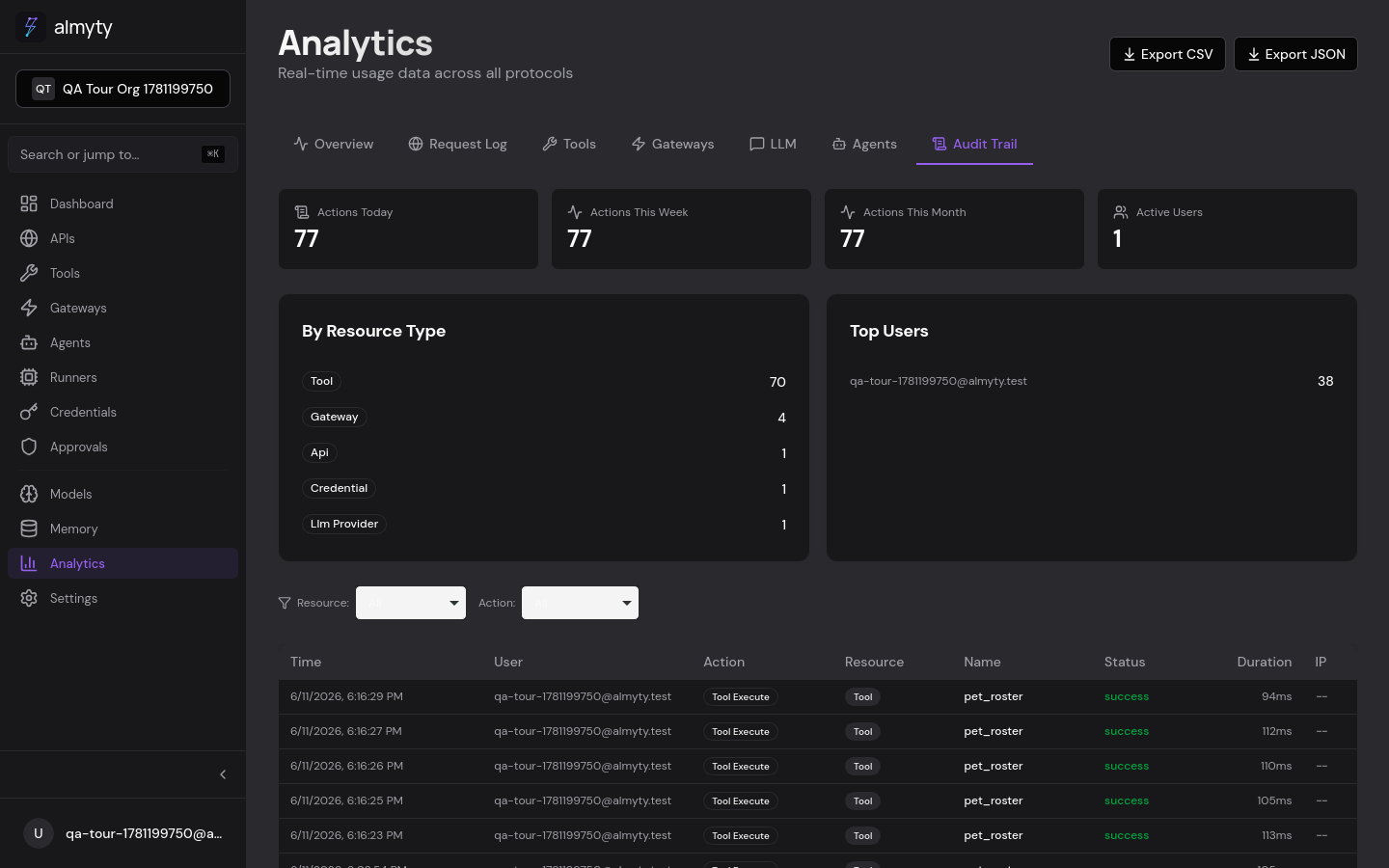
Confirm what’s captured. Every tool call, approval decision, config change, and run is already in the audit trail, no instrumentation to add.
-
Export it: pull the audit log as CSV/JSON from Analytics, or stream events into your SIEM pipeline (Splunk, Datadog, or any log sink).
-
Alert on it: build detections in your existing tooling: a spike in refunds, an agent touching a resource it shouldn’t, an approval bypassed.
-
Retain it: keep the exported trail for the window your compliance regime requires; it’s the evidence for an audit.
-
Tie it to identity: with SSO/SCIM, the “who” is a real directory user, not a shared key.
Make it yours
- Feed anomalies back to an on-call agent that summarizes them.
- Scope exports per team so each business unit sees only its own trail.
- Combine with approval policies so the trail shows the full decision chain.
Uses: Enterprise · Audit · SIEM · Security