Agentic loops
An agentic loop is the pattern behind autonomous AI: reason, act, observe, repeat until a stopping condition. The agent takes an action, sees the result, decides the next move, and keeps going without a human between steps. The current wisdom (“loop engineering”) is that the loop, not the model, is what separates a reliable agent from a demo.
almyty’s autonomous agents are governed agentic loops. You bring the model; almyty gives you the loop, and the controls that make it safe to leave running.
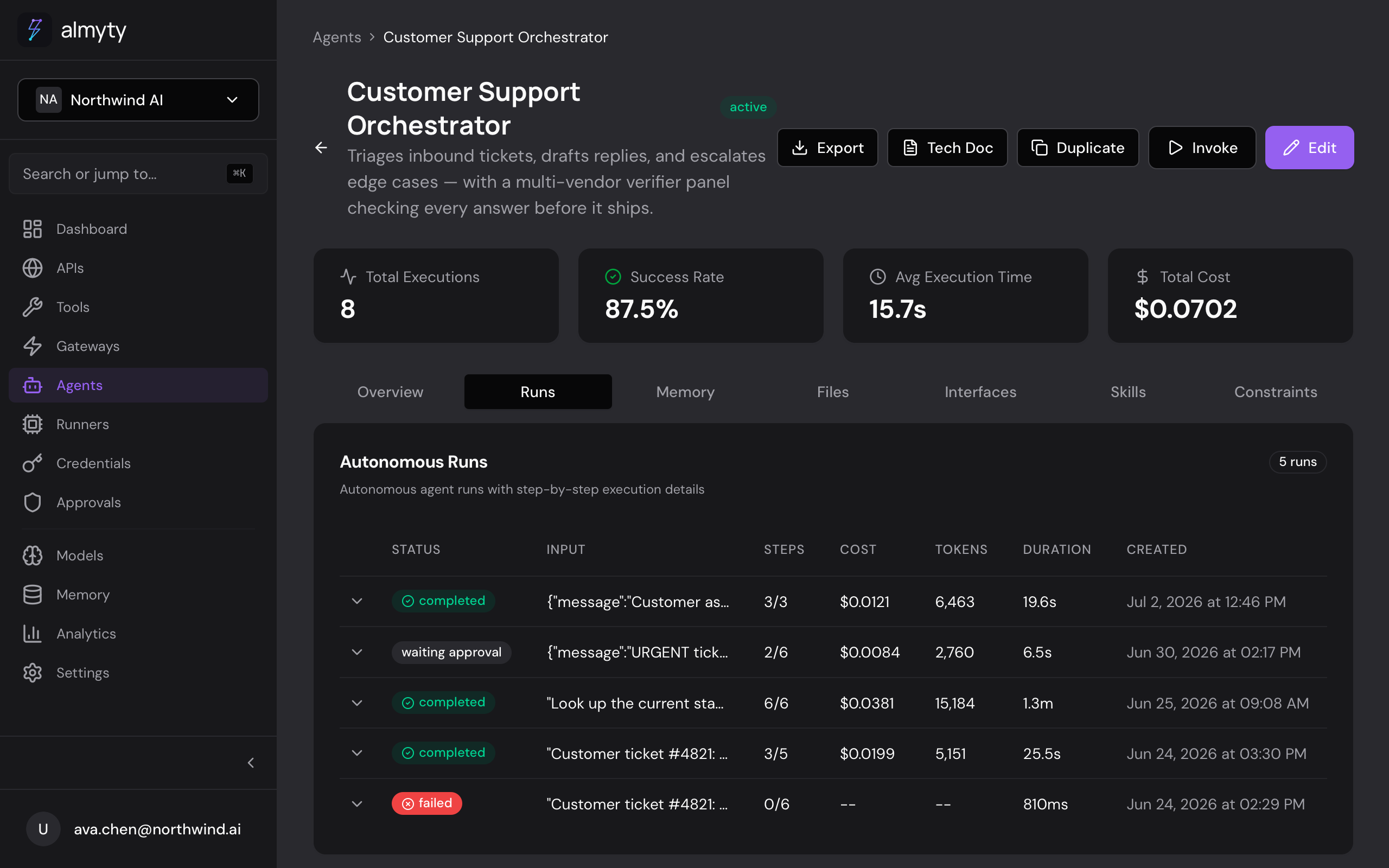
The loop, in almyty
Each autonomous run is a loop of steps, and you can see every one:
- Reason: the primary model decides what to do next.
- Act: it calls a tool (an operation on a connected API, an npm/SDK function, a runner command).
- Observe: the tool’s result feeds back into context.
- Evaluate & repeat: it continues until the task is done or a stop condition fires.
A real run from the demo’s support agent: tool_call, Lookup Order Status (NW-10428), observe, draft, verify, the reviewer caught an inconsistency, 1 revision, pass. Three to six steps, visible end to end.
Loop engineering: the knobs almyty gives you
The differentiator isn’t that agents loop; it’s that you can engineer the loop:
- Self-correction: a cross-vendor verifier panel re-checks each result; on failure the agent revises and retries. See verification.
- Termination: a revise budget (e.g. 2 revisions,
any_fail_blocks) is the stop condition, so a loop can’t spin forever. - Guardrails inside the loop: always-on constraints, some learned from past failures, bound what each iteration may do.
- Multi-agent loops: collaboration runs several agents in
sequentialchains,parallelfan-out,racefirst-to-finish, ordebate(rounds of argument settled by a judge). - Human-in-the-loop:
request_approvalpauses the loop for a person before an irreversible step, then resumes. - Loops that compound: memory carries context across runs, and a good run can be promoted to a reusable skill.
Why it matters
A bare model call answers once. An agentic loop keeps working: checking itself, correcting, and stopping when it should. almyty makes that loop observable (every step in the run view), bounded (revise budgets, constraints), and governed (verification, approvals, audit), so you can put a loop in production, not just a notebook.